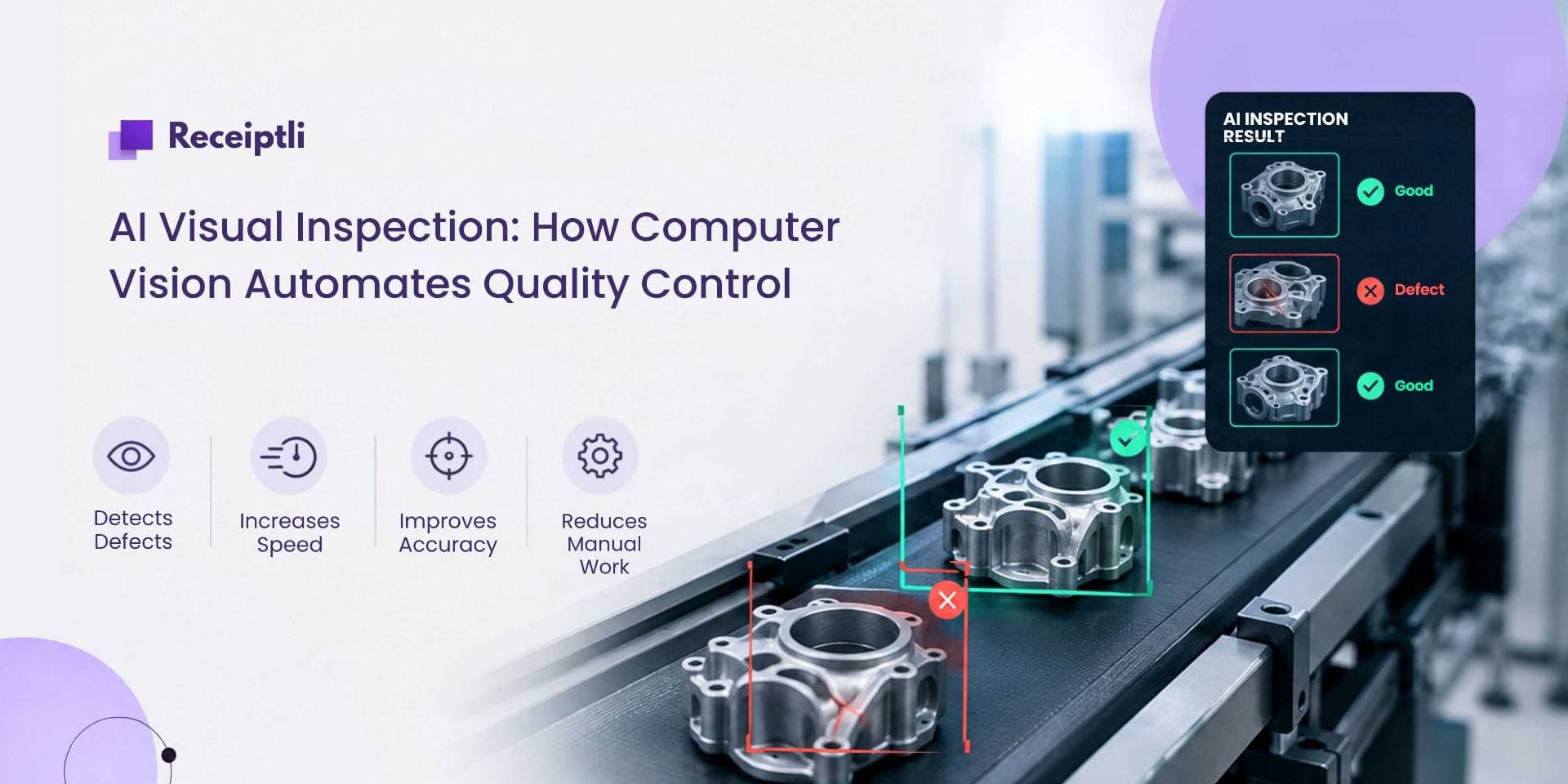
Manufacturing quality control has traditionally depended on human inspectors and rule-based machine vision systems. While these methods still have a place, manufacturers increasingly need faster and more consistent ways to identify defects, verify products, and maintain quality at scale.
AI visual inspection combines cameras, computer vision, and artificial intelligence to analyze products, parts, surfaces, labels, and assemblies. Instead of relying only on fixed rules, AI models can learn visual patterns and identify defects, anomalies, or inconsistencies in production environments.
What Is AI Visual Inspection?
AI visual inspection is an automated quality control process that uses cameras and AI-based image analysis to determine whether an item meets defined quality requirements.
Depending on the application, an inspection system may identify:
-
Product defects or damage
-
Missing or incorrectly positioned components
-
Surface abnormalities
-
Contamination
-
Incorrect labels or packaging
-
Assembly errors
-
Out-of-spec products
Traditional machine vision often depends on predefined rules. AI-based inspection can provide more flexibility by learning from examples and recognizing visual patterns that may be difficult to define manually.
The goal is not necessarily to replace quality teams. Instead, AI can handle repetitive visual checks while people focus on exceptions, decision-making, and continuous improvement.
How Does AI Visual Inspection Work?
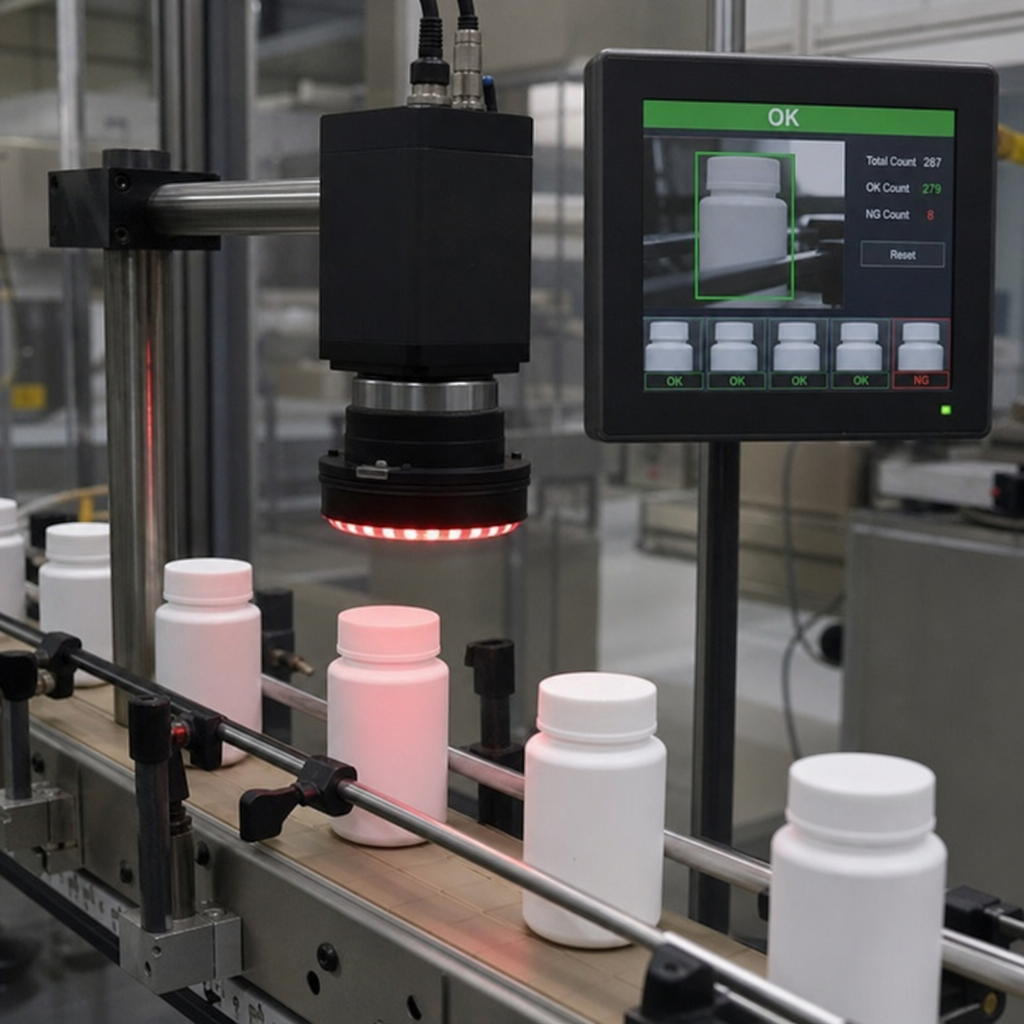
A typical automated inspection system follows several connected steps:
1. Image Capture
Cameras capture images or video of products as they move through the inspection area. Lighting, camera position, lens selection, and image quality can have a major effect on inspection performance.
2. Image Processing and AI Analysis
The captured images are processed and analyzed by an AI model. Depending on the inspection requirement, the system may use image classification, object detection, segmentation, or anomaly detection.
3. Decision Making
The system compares the model's output against predefined quality requirements. It can then classify an item as acceptable, defective, or requiring further review.
4. Action and Integration
Inspection results can be connected to production workflows, dashboards, alerts, or other systems. This allows teams to respond to defects rather than simply recording them.
For some applications, processing can happen close to the camera or device, while others may use cloud or hybrid infrastructure.
Why Manufacturers Are Moving Toward AI Inspection
Manual inspection can become difficult when production volumes increase or products contain small and complex defects. Inspectors may also experience fatigue when performing the same visual checks repeatedly.
AI visual inspection can provide several advantages:
-
Consistency: The same inspection criteria can be applied repeatedly.
-
Speed: Large numbers of products can be screened without slowing production.
-
Scalability: Automated inspection can support higher production volumes.
-
Complex defect detection: AI can identify visual patterns that may be difficult to define with simple rules.
-
Traceability: Inspection results can create useful records for quality analysis.
-
Human-AI collaboration: Inspectors can focus on difficult cases and quality decisions.
For businesses considering the transition, it is also useful to understand how AI defect detection works in practical manufacturing environments.
Common Applications of AI Visual Inspection
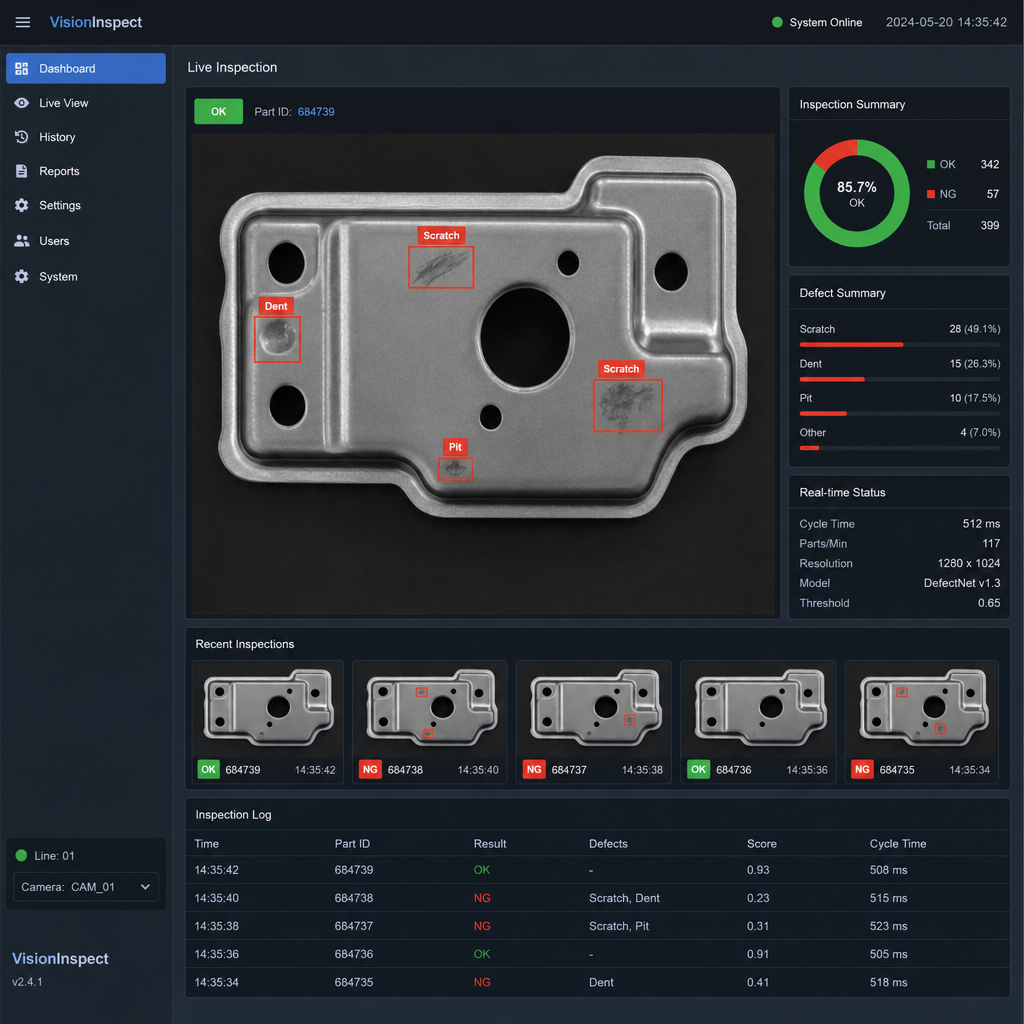
AI image analysis can support quality control across many industries.
Manufacturing
Manufacturers can use computer vision to identify surface defects, incorrect assemblies, damaged components, or missing parts before products move to the next production stage.
Automotive
Computer vision can inspect components, assemblies, vehicle parts, and production processes for defects or inconsistencies.
Electronics
AI inspection can help identify small component defects, incorrect placements, damaged parts, and assembly issues where visual accuracy is important.
Packaging and Consumer Goods
Inspection systems can verify labels, packaging, product appearance, fill levels, and other visual characteristics.
Textiles, Metals, and Plastics
AI-based systems can identify surface defects, irregularities, scratches, contamination, and other production issues.
The exact application depends on the product, defect type, camera setup, available training data, and required inspection speed.
What Does an Automated Inspection System Need?
AI is only one part of a complete visual inspection system.
A practical solution may include:
-
Industrial cameras and lenses
-
Controlled lighting
-
Image processing hardware
-
AI and computer vision models
-
Data storage and management
-
Production system integrations
-
Dashboards and alerts
-
Human review workflows
The quality of the captured images is especially important. Poor lighting, inconsistent camera positioning, or insufficient training examples can reduce model performance even when the underlying AI technology is capable.
How Aeyron Approaches AI & Computer Vision
AI visual inspection requires more than simply selecting an AI model. The complete solution needs to connect visual data, computer vision, real-time processing, and business workflows.
Aeyron's AI & Computer Vision services focus on building vision systems for detection, tracking, and automation across areas including retail, industry, and security. Its service offering also includes real-time detection and tracking, quality assurance automation, and retail analytics and loss prevention.
This makes computer vision relevant to more than traditional factory inspection. The same underlying capabilities can support applications such as real-time video analysis, safety monitoring, retail analytics, and automated quality checks.
For an AI visual inspection project, the starting point should be a clearly defined business problem: what needs to be inspected, which defects matter, how quickly decisions must be made, and what should happen after a defect is detected.
What Should You Consider Before Implementing AI Inspection?
Before investing in an automated inspection system, businesses should evaluate:
- Inspection objective: What exactly needs to be detected?
- Defect cost: What happens when a defect is missed or incorrectly flagged?
- Image quality: Can the camera consistently capture useful images?
- Training data: Are there enough representative examples?
- Production integration: How will inspection results enter the existing workflow?
- Human review: When should an inspector verify the AI's decision?
- Maintenance: Who will monitor performance and update the system?
Starting with a focused pilot, such as one product, production line, or specific defect—can make implementation easier to evaluate before expanding the system.
The Future of AI Visual Inspection
AI visual inspection is moving beyond simple pass-or-fail decisions. Inspection data can become part of a broader production intelligence system, where visual results are analyzed alongside machine settings, production conditions, shifts, batches, and maintenance information.
This can help businesses understand not only which products are defective, but also identify patterns that may point toward production problems.
As computer vision becomes more integrated with automation and real-time analytics, visual inspection can become an important part of connected quality control.
FAQs
1. What is AI visual inspection?
AI visual inspection uses cameras, computer vision, and AI models to automatically analyze products or processes for defects, abnormalities, missing components, or other quality issues.
2. What is the difference between AI visual inspection and traditional machine vision?
Traditional machine vision commonly relies on predefined rules, while AI visual inspection can learn visual patterns from training data. AI can therefore be useful for inspection tasks where defects or variations are difficult to describe using fixed rules.
3. Can AI visual inspection replace human inspectors?
Not necessarily. AI can automate repetitive visual checks, while human inspectors can handle exceptions, investigate difficult cases, and make quality decisions that require broader context.
4. What industries use AI visual inspection?
AI visual inspection can be used across manufacturing, automotive, electronics, packaging, consumer goods, textiles, metals, and plastics. Computer vision can also support related applications in retail and security.
Final Takeaway
AI visual inspection gives businesses a way to automate repetitive visual quality checks while improving consistency, speed, and traceability.
The technology combines cameras, computer vision, AI models, and production workflows to turn visual information into actionable quality data. However, successful implementation depends on more than the AI model itself. Image quality, training data, integration, human review, and ongoing monitoring all matter.
For businesses exploring computer vision for quality control, automation, detection, or real-time analysis, Aeyron's AI & Computer Vision capabilities provide a foundation for building vision-based systems around real-world operational requirements.
Aeyron Technologies
· 6 min read


